


What problem does Segment Stats on DNA Match Pages solve?
Ancestry shows the total shared cM and the number of segments for every match, but the two figures that matter most when you are judging how close a match really is, the unweighted shared DNA and the longest segment, are hidden inside the Shared DNA pop-up, one match at a time. Nothing on Ancestry tells you the average size of the segments you share. Segment Stats on DNA Match Pages puts all of those numbers on the match page itself, so you can size up a match at a glance without opening anything.
How does Segment Stats on DNA Match Pages work?
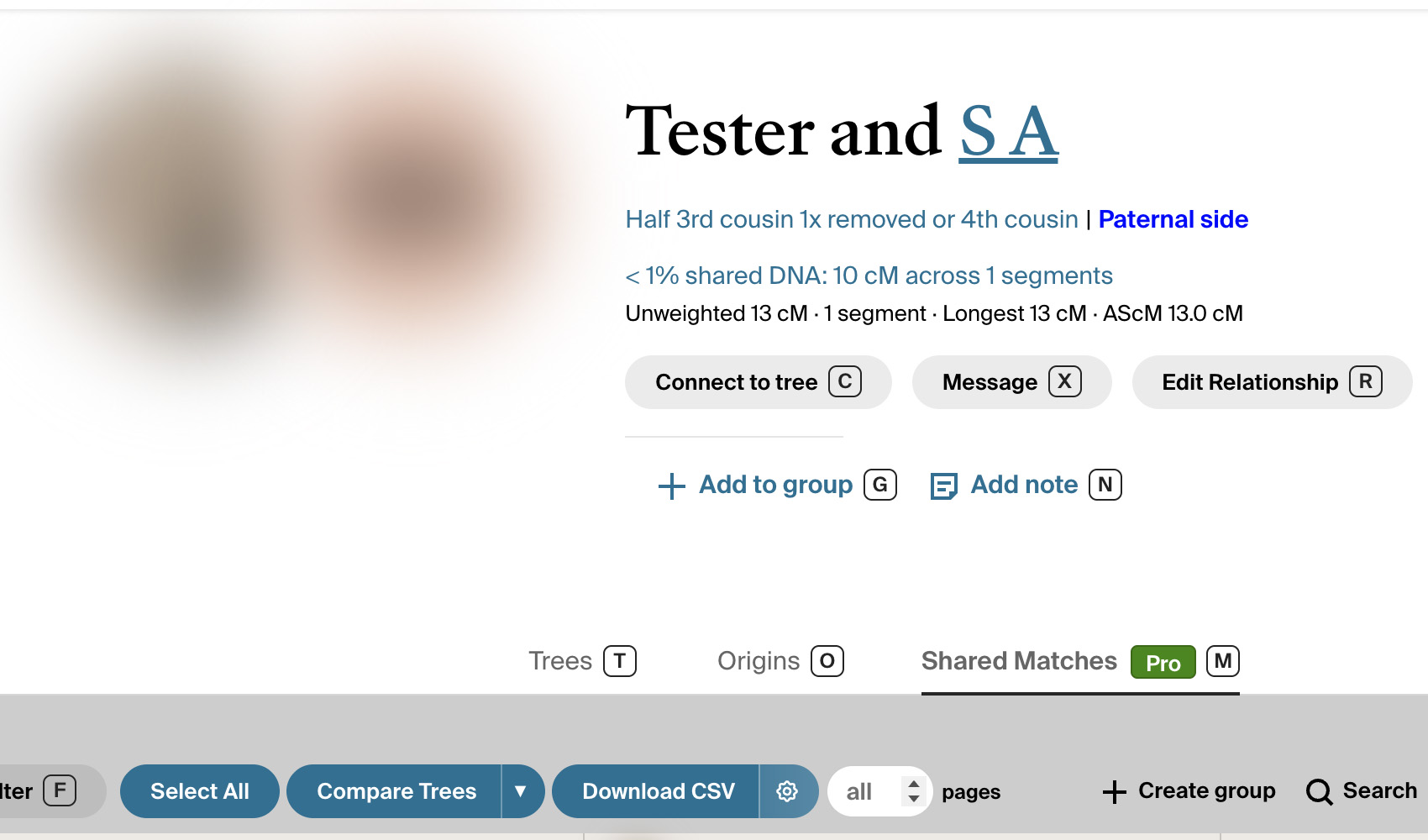
A line is added under the shared DNA amount on every Ancestry DNA match page showing the unweighted shared cM, the number of segments, the longest segment and the average segment size (AScM, unweighted cM divided by segments). Ancestry only shows these values inside the Shared DNA pop-up. The line appears on every tab of the match page (Trees, Origins and Shared Matches) and reads, for example, Unweighted 665 cM · 28 segments · Longest 64 cM · AScM 23.8 cM. Hovering over the line shows a reminder of how the average is calculated.
The unweighted figure is the amount of DNA you share before Ancestry’s Timber algorithm removes segments it considers common to a whole population, which is why it can be higher than the shared cM shown on the match list. Ancestry counts segments and measures the longest segment on the unweighted DNA, so the average is calculated from the unweighted total as well. For researchers with endogamous ancestry, where matches share many small segments inherited from a shared population rather than a recent ancestor, the longest segment and the average segment size are far better guides to which matches are worth pursuing than the total alone. A match with a long single segment and a high average is much more likely to be a genuine close cousin than a match with the same total spread across dozens of small pieces, and many researchers treat a longest segment of around 20 cM as the point where a match deserves a closer look. These figures are also useful when you are sorting matches into coloured groups.
The same figures can be added to your CSV downloads. With Ancestry additional DNA details turned on, the Download Matches Pages as CSV File and Download Shared Matches as CSV features add Unweighted cM, Longest Segment cM and Avg Segment cM columns to every file.
How do I use Segment Stats on DNA Match Pages?
- Ensure Segment Stats on DNA Match Pages is enabled in the Genealogy Assistant pop-up panel.
- Open any match from your AncestryDNA match list or from a shared matches list.
- Look directly under the shared DNA amount at the top of the page. The unweighted cM, number of segments, longest segment and average segment size are listed there, and they stay in place as you move between the Trees, Origins and Shared Matches tabs.
- Hover over the line to see how the average segment size is calculated.
Segment Stats on DNA Match Pages is a feature of the software Genealogy Assistant.
Genealogy Assistant is an extension for Google Chrome, Mozilla Firefox, Microsoft Edge and Apple Safari which supercharges your family history research by adding over 100 custom features to popular genealogy websites like Ancestry, MyHeritage, FamilySearch, FamilyTreeDNA and more. You can watch a full video walkthrough on YouTube.
Install Genealogy Assistant for Google Chrome | Install for Mozilla Firefox | Install for Microsoft Edge | Install for Apple Safari