


What problem does Add Advanced Search to Profiles solve?
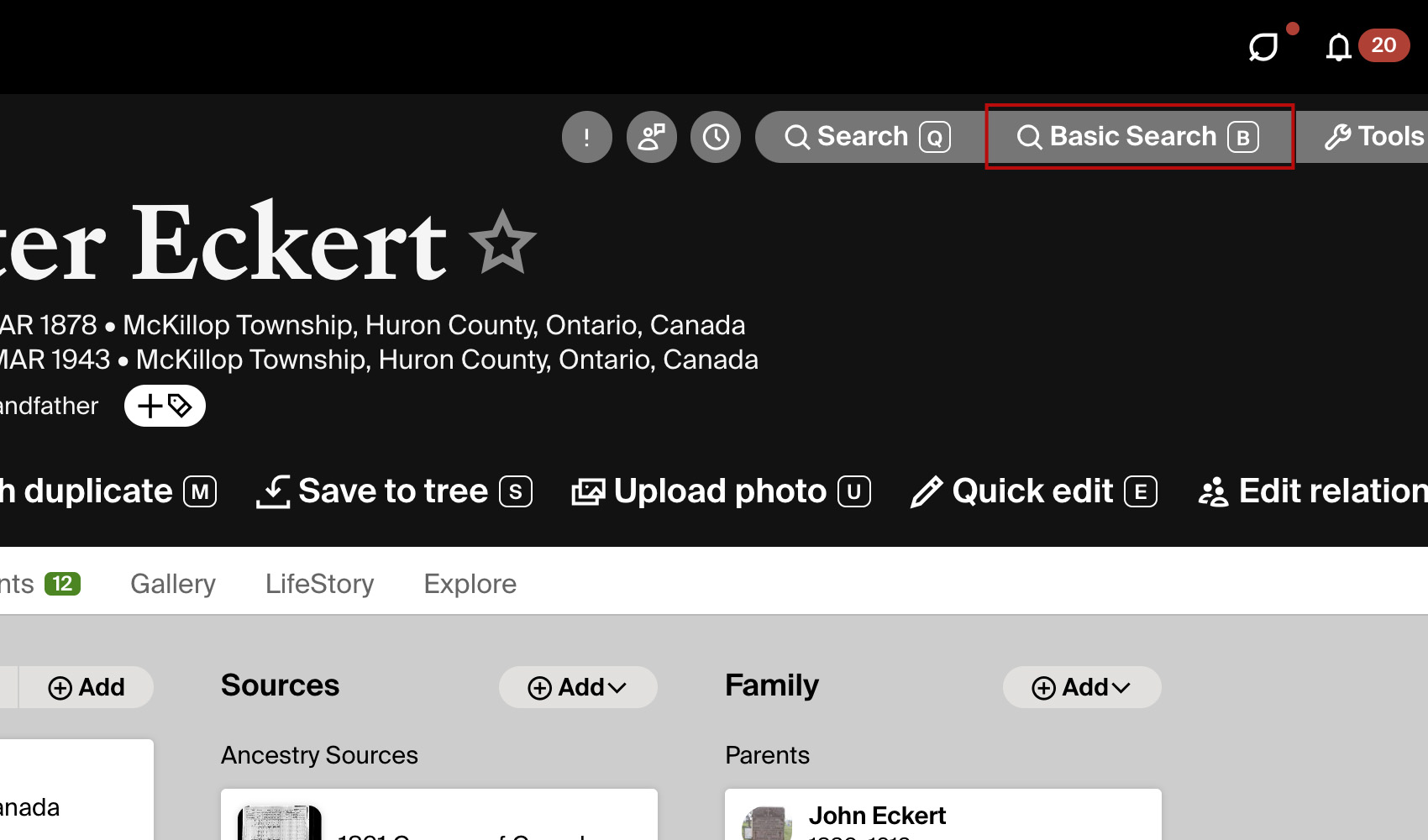
Searching for a person across multiple genealogy sites usually means opening each site, retyping their name, birth date, and death date, and running each search one at a time. Add Advanced Search to Profiles puts a single Advanced Search button on every Ancestry profile page with a dropdown that can search eight major genealogy sites (pre-filled from the profile), or open every site you have ticked in new tabs at once. It also adds quick research links next to the birth and death places, so a location is one click away from the records that cover it.
How does Add Advanced Search to Profiles work?
On any person profile in an Ancestry family tree, a new Advanced Search button is added alongside the existing Search button. Hovering over it opens a dropdown menu with links to search for the person on multiple genealogy sites. Each link automatically pulls the person’s name, birth and death dates, birth and death places, parents names, and spouse name straight from the profile, so you don’t have to retype anything. Each search opens in a new tab. Every site in the menu has a tick box, and the Search selected option at the top opens every ticked site at once. Untick the sites you never use and the choice is remembered on every profile.
Small research buttons are also added beside the birth and death place names at the top of the profile. A FS Wiki button searches that location in the FamilySearch Research Wiki, opening the matching article in a new tab. Civil registration buttons appear beside a place when an index covers both the place and the year of the event: FreeBMD and GRO for England and Wales, ScotlandsPeople for Scotland, IrishGenealogy for Ireland, the state registries of New South Wales, Queensland, Victoria, Western Australia and Tasmania, NZ BDM for New Zealand, and the archives of Nova Scotia, New Brunswick, British Columbia and Manitoba. Each button fills in that site’s own search form with the person’s name and year, adding the sex, the mother’s maiden name or the parents’ names where the index records them, and runs the search for you. A button is left out when the index is closed for that year, for example a birth less than 100 years old on most registries, so a button that is shown is one worth clicking. The full list, with the years each index covers, is under Place Research Links below.
The GRO index needs a free GRO account, and the site signs you out after a short while. If you are not signed in when you click the GRO button, the GRO login page opens with a note showing the search that is waiting, and the search runs on its own as soon as you log in. IrishGenealogy asks you to accept its declaration the first time; after that its searches run straight away.
The age the person was when they died is added to the top of the profile as well, on the death line just after the date. Where the tree records a full date for both the birth and the death, the age is exact. Where only a year is recorded the age is given as a range, such as 80 to 81, because the months are unknown. A person who is still living shows their age today instead, and a person whose death date has not been recorded shows no age at all.
How do I use Add Advanced Search to Profiles?
- Ensure Add Advanced Search to Profiles is enabled in the Genealogy Assistant pop-up panel.
- Open any person profile in any Ancestry family tree. Their age when they died is shown at the top of the profile, on the death line just after the date.
- Hover over the new Advanced Search button to open the dropdown menu, then click the site you want to search. The results will open in a new tab, pre-filled with the person’s details.
- Click the FS Wiki button next to a birth or death place to open the matching FamilySearch Research Wiki article, or any civil registration button beside it (FreeBMD, GRO, ScotlandsPeople, IrishGenealogy, NSW BDM and so on) to run that index’s search for the event in a new tab. The GRO button asks you to log in to your GRO account first if the site has signed you out.
- To change how place names are matched for the FamilySearch Wiki, open the Genealogy Assistant pop-up panel and click the settings icon next to Add Advanced Search to Profiles. This opens the Advanced Settings page at the FamilySearch Wiki Links section. Tick Only search state/province and country for broader matches, or leave it unticked for more specific matches. Settings save automatically.
Search Destinations
- Search Ancestry (Basic) runs a simple Ancestry search using just name, birth date and place, and death date and place.
- Search FamilySearch Records
- Search FamilySearch Tree
- Search on FindMyPast
- Search on MyHeritage
- Search on WikiTree
- Search on FindAGrave
- Search on Newspapers.com
- Search selected opens every site whose box is ticked in new tabs. Untick a site to leave it out; the ticks are remembered.
Place Research Links
- FS Wiki opens the FamilySearch Research Wiki article for the birth or death place, so you can see what records exist for that location.
- FreeBMD appears next to places in England and Wales and searches the FreeBMD index of births and deaths (1837 to 2000) for that person and year, adding the mother’s maiden name on births from 1911.
- GRO also appears next to places in England and Wales and searches the General Register Office index of births (1837 to 1934 and 1984 onward) and deaths (1837 to 1957 and 1984 onward) for that person and year, adding the mother’s maiden name on births and the age at death on deaths. A free GRO account is required. If you are not signed in, the search runs once you log in.
- ScotlandsPeople appears next to places in Scotland and searches the statutory registers (from 1855) or the old parish registers (1553 to 1854) of births and deaths for that person, sex and year. Births are shown once 100 years old and deaths once 50 years old.
- IrishGenealogy appears next to places in Ireland, and in Northern Ireland before 1922, and searches the civil records of births (from 1864) and deaths (from 1871). Births are shown once 100 years old and deaths once 50 years old.
- NSW BDM appears next to places in New South Wales and searches the registry’s family history index (from 1788) by name, year and the parents’ first names. Births are shown once 100 years old and deaths once 30 years old.
- Qld BDM appears next to places in Queensland and searches the registry’s family history index (from 1829) by name, year and the parents’ first names. Births are shown once 100 years old and deaths once 30 years old.
- Vic BDM appears next to places in Victoria and searches the registry’s family history index (church records from 1836, civil from 1853) by name and year. Births are shown once 100 years old and deaths once 30 years old.
- WA BDM appears next to places in Western Australia and searches the online index of births (1841 to 1925) and deaths (1841 to 1995) by name, year and the parents’ first names.
- Tas Names appears next to places in Tasmania and searches the Libraries Tasmania Names Index of births (1803 to 1933) and deaths (1803 to 1939) by name.
- NZ BDM appears next to places in New Zealand and searches the historical records index (from 1848) by name and year. A birth is shown once it is 100 years old, or for someone who has died, once it is 80 years old or 50 years after the death. A death is shown once it is 50 years old or 80 years after the birth.
- NS Archives appears next to places in Nova Scotia and searches the provincial vital statistics of births (1864 to 1924) and deaths (1864 to 1974) by name and year.
- NB Archives appears next to places in New Brunswick and searches the provincial vital statistics (from 1800) by name, year and the parents’ first names. Births are shown once 95 years old and deaths once 50 years old.
- BC Archives appears next to places in British Columbia and searches the genealogy index of births (from 1854) and deaths (from 1872) by name and year. Births are shown once 122 years old and deaths once 21 years old.
- MB Vital Stats appears next to places in Manitoba and searches the provincial index (from 1882) by name and the year of the event. Births are shown once 100 years old and deaths once 70 years old.
Add Advanced Search to Profiles is a feature of the software Genealogy Assistant.
Genealogy Assistant is an extension for Google Chrome, Mozilla Firefox, Microsoft Edge and Apple Safari which supercharges your family history research by adding over 100 custom features to popular genealogy websites like Ancestry, MyHeritage, FamilySearch, FamilyTreeDNA and more. You can watch a full video walkthrough on YouTube.
Install Genealogy Assistant for Google Chrome | Install for Mozilla Firefox | Install for Microsoft Edge | Install for Apple Safari